Per-material 4-step ramps: why pixel-art metal stops looking like wood
A 48×48 sprite rarely has room for painterly texture. When wood planks, iron straps, and brass locks share one value ramp, every fitting blurs into the body. Giving each material its own 3–4 step ramp—and its own edge highlight rule—makes materials read at 1× scale inside the same 32-colour palette.
Why one shared ramp turns metal into wood
At 48×48 pixels, a treasure chest's iron band is only three pixels wide and its corner cap is a 3×3 square. You cannot rely on fine surface grain or high-resolution reflections to tell the player where wood stops and metal starts.
If all three surfaces borrow from a single ramp, the geometry stays intact—plank seams, rivets, and keyhole are still drawn in the exact same pixels—yet the chest reads like a single carved block of brown timber. Brightness alone separates shapes, not materials.
Two things make materials immediately legible at game scale: first, each surface owns a dedicated 3–4 step ramp (wood w0–w3, iron n0–n3, brass g0–g3); second, each material uses its brightest step differently. Matte wood concentrates darks in plank seams, iron reserves an extra peak tone (n4) for rivets and tight shoulders, and polished brass puts a sharp 1-pixel g3 rim along every top edge.
Measured on two real 48×48 props
To isolate the effect of per-material ramps without altering a single silhouette or lighting rule, we took frame 0 of the Treasure Chest (closed-down) from Arcane Curiosities Vol.1 and collapsed its iron (n0–n3, plus n4) and brass (g0–g3) pixels onto the 4-step wood ramp (w0–w3) in the same lightness order, leaving wood and the #17121f outline ink unchanged. That drops the sprite from 14 colours to 5 (w0–w3 plus ink). Exactly 254 of 910 opaque pixels (27.9%) change: 172 iron pixels (160 across n0–n3 plus 12 rivet and peak specular pixels in n4) and 82 brass pixels (g0–g3). Wood accounts for 525 pixels (w0–w3) and ink for 131 pixels.
We ran the same test on a prop with five distinct materials: frame 0 of the Alembic (idle-green, 48×48, 963 opaque pixels). Collapsing brass (g0–g3, 83 px—including the shared g3 flame core), green brew (e0–e3, 145 px), glass rims and wick collar (n2/n4/n5 and b3, 61 px), and flame body (r1–r3, 21 px) onto the wood-and-copper ramp (w0–w4, 356 px) shrinks the sprite from 21 colours to 6 (w0–w4 plus 297 ink pixels). Exactly 310 of 963 opaque pixels (32.2%) differ—and without separate ramps, the glass bulb, boiling potion, brass lamp, and flame collapse into one muddy brown silhouette.
Treasure Chest (48×48, closed-down frame 0)

Single ramp: iron & brass collapsed onto wood (w0–w3 + ink, 5 colours)

Per-material ramps: real chest.js sprite (wood, iron + n4, brass + ink, 14 colours)

Pixel diff: 254 of 910 opaque pixels (27.9%) separate iron and brass from wood
Alembic (48×48, idle-green frame 0)

Alembic: all materials collapsed onto w0–w4 + ink (6 colours)

Alembic: real multi-material render (wood/copper, brass, glass, brew, flame — 21 colours)

Pixel diff: 310 of 963 opaque pixels (32.2%) carry non-wood material ramps
Per-material ramps used in chest-closed-down frame 0 (910 opaque pixels, 14 of 32 master colours, including 131 outline ink pixels in #17121f).
One ramp declaration, one shading branch per material
Our style contract (STYLE.md rules 5 and 6) sets two plain rules for every prop: shade each material with 3–4 steps (iron n0–n3 plus n4 specular, wood w0–w3, brass g0–g3 with a g3 top-left rim), and give every material its own ramp instead of detailing only the hero part. In chest.js, line 19 declares those three 4-step arrays right at the top of the file.
Lines 219–246 show how tone() branches by material tag (b.mat). Wood computes plank seams from neighbouring plank IDs (seam(rt) || seam(dn) drops to w0; seam(up) || seam(lf) steps up) and places countable grain marks rather than random noise. Iron nudges its band edges brighter on the lit left (!samePart(lf)) and darker on the right (!samePart(rt)), then promotes rivets and high-angle peaks (b.d > 0.85) to n4. Brass uses a neighbour check of its own material (!same(up)) to lay a crisp 1-pixel g3 glint across every top brass rim, while keeping the keyhole pixel in ink.
chest.js line 19: three 4-step material ramps drawn from the shared 32-colour master palette.
const WOOD = ["w0", "w1", "w2", "w3"], IRON = ["n0", "n1", "n2", "n3"], GOLD = ["g0", "g1", "g2", "g3"];chest.js lines 219–246: per-material shading in tone(). Each branch pairs its own ramp with surface-specific edge rules—plank seams for wood, n4 rivets for iron, and a 1-px g3 top rim (!same(up)) for brass.
if (b.mat === "wood" || b.mat === "under") { let lv = b.mat === "under" ? (b.bounce ? 2 : 1) + (fx.glow || 0) : level(b.d); const seam = (q) => q && q.s === b.s && q.k !== b.k; if (seam(rt) || seam(dn)) lv = 0; else if (seam(up) || seam(lf)) lv = Math.min(3, lv + 1); else if (b.z !== undefined && Math.floor(b.z) % 4 === 2 && hash(b.k * 3 + (b.s === "front" ? 0 : 11), Math.floor((b.u + 40) / 4)) > 0.62 && Math.floor(b.u + 40) % 4 !== 0) lv = Math.max(0, lv - 1); if (!b.lid && up && up.lid && b.s !== "top") lv = 0; // the lid's lip shades the body's top plank if (!up && lv > 0) lv = Math.min(3, lv + 1); // the top silhouette catches the light key = WOOD[Math.max(0, Math.min(3, lv))]; if (fx.backlit && b.lid && !up) key = "g2"; // gold glow behind the lid rims its top edge } else if (b.mat === "iron") { let lv = level(b.d); if (!samePart(lf) && !b.rim) lv = Math.min(3, lv + 1); else if (!samePart(rt) && !b.rim) lv = Math.max(0, lv - 1); if (b.rim && !samePart(up)) lv = Math.min(3, lv + 1); if (b.ring) lv = Math.max(lv, 2) + (!samePart(up) || !samePart(lf) ? 1 : 0) - (!samePart(dn) ? 1 : 0); if (b.knuckle) lv = b.z > H ? 3 : 1; lv = Math.max(0, Math.min(3, lv)); key = b.rivet ? "n4" : lv === 3 && (b.d > 0.85 || (b.knuckle && !samePart(lf))) ? "n4" : IRON[lv]; if (fx.backlit && b.lid && !up) key = "g1"; } else if (b.mat === "brass") { const same = (q) => q && q.mat === "brass"; let lv = b.d > 0.5 ? 2 : 1; if (!same(up)) lv = b.d > 0.1 ? 3 : 2; else if (!same(lf)) lv = 2; else if (!same(dn) || !same(rt)) lv = 0; if (fx.glint) lv = Math.min(3, lv + fx.glint(px, py)); key = b.key ? "ink" : GOLD[lv];Practical rules for separating materials at 32×32–48×48
You do not need ten shades per surface—in fact, extra midtones blur small fittings. Three to four intentional steps per material are enough when each material occupies a distinct hue family in your master palette and uses its highlight step with different sharpness.
Before adding small surface marks, verify that the prop already reads as separate materials in flat lighting. Then place countable material cues—seams on wood, rivets on iron, a 1-pixel rim on brass, or a hard white/cyan streak on glass—so the eye recognises each surface at 1× scale.
- Assign every distinct material its own 3–4 step ramp from one shared master palette (for example: wood w0–w3, iron n0–n3, brass g0–g3).
- Keep every secondary fitting on its own ramp too—do not render the main body carefully and leave straps, collars, or brackets flat.
- Reserve one extra specular step (such as n4 on iron) only for tight peaks and countable rivets so matte surfaces and metal stay distinct.
- Differentiate metals by edge contrast: brass catches a crisp 1-pixel highlight along top-left borders (!same(up)), while matte wood puts contrast into plank seams.
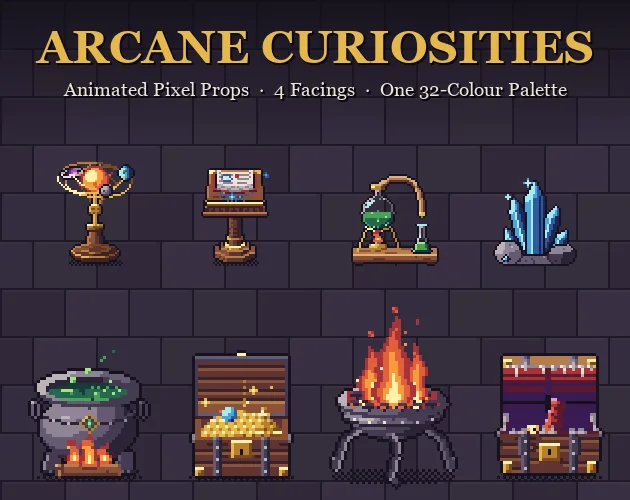 Arcane Curiosities Vol.112 animated props · 52 animations
Every sprite in these notes ships with its source
Tessarune includes all 72 Arcane Curiosities props and their full Tessarune source files as a bonus, so you can inspect, edit, and re-render every technique locally.