Countable marks, not per-pixel noise
When a flat plank or cast-iron belly looks too bare at 48×48, the most common reflex is to sprinkle random ±1-step noise across the surface. That speckle breaks clean light planes and destroys legibility at 1× scale. Keep surface tones smooth, then place a small set of countable, physical marks—plank seams, grain dashes, rivets, and 1-pixel rims.
Why per-pixel noise ruins small sprites
Pixel art works through clusters: clean contiguous planes of light, midtone, and shadow that tell the eye how a surface curves in space. Once you perturb individual pixels up or down by one ramp step to fake wood grain or rough iron, those clusters fracture into single-pixel confetti.
Even when every noisy pixel stays inside the exact same 32-colour master palette and the silhouette outline never moves, the eye stops reading flat boards or curved metal. Instead, planks turn speckled like coarse cork, iron bands lose their bevels, and every small detail—rivets, keyhole, brass rims—has to compete against background static.
The fix is not leaving surfaces blank; it is replacing random grain with countable marks. Every detail pixel should correspond to a physical feature you can point to and count: a seam between two planks, a short horizontal grain dash, a rivet spaced evenly along a strap, or a crisp 1-pixel glint along a brass edge.
Measured on two real 48×48 props
To test per-pixel noise in isolation, we took frame 0 of the Treasure Chest (closed-down, 48×48, 910 opaque pixels) from Arcane Curiosities Vol.1 and applied deterministic ±1 ramp-step jitter to its wood (w0–w3) and iron (n0–n3) pixels while leaving the #17121f ink outline (131 px), iron n4 rivets (12 px), and brass (g0–g3, 82 px) untouched. Both versions use the exact same 14 colours. Exactly 392 of 910 opaque pixels (43.1%) change—303 of 525 wood pixels and 89 of 160 iron pixels (57.2% of the wood-and-iron surface). By contrast, the real chest uses zero per-pixel noise in its tone choice and relies on four countable mark groups: 3 plank seams (136 px total: 68 dark groove + 68 lit lip), 5 horizontal wood-grain dashes (11 px), 10 iron rivets (12 px in n4), and 1-pixel brass top-edge rims (19 px in g3).
We ran the exact same ±1 jitter test on frame 0 of the Bubbling Cauldron (idle-green, 48×48, 1,238 opaque pixels), perturbing only iron (n0–n3, 661 px) and firewood logs (w1–w3, 84 px) while leaving n4 specular highlights and rivets (39 px), w4 end-grain (1 px), brass sigil (14 px), fire (105 px), brew (142 px), and ink (192 px) intact. Exactly 391 of 1,238 opaque pixels (31.6%) change—346 of 661 iron pixels and 45 of 84 wood pixels (52.5% of the iron-and-wood surface; colour count rises from 21 to 22 within the same 32-colour palette as w1 jitters down into w0). On the real cauldron, the belly stays smooth cast iron so its countable marks read instantly: 4 rivets spaced across the curved band, one curved n4 shoulder specular, 4 toe highlights on the feet, and 2 bark marks on the front log.
Treasure Chest (48×48, closed-down frame 0)

Per-pixel noise: ±1 ramp jitter on wood & iron (392 / 910 px changed, same 14 colours)

Countable marks: real chest.js render (0 noise · 3 seams, 5 grain dashes, 10 rivets, 1-px brass rims)

Pixel diff: 392 of 910 opaque pixels (43.1%) turn noisy under ±1 step jitter
Bubbling Cauldron (48×48, idle-green frame 0)

Cauldron with ±1 noise on iron & logs (391 / 1,238 px changed, 52.5% of iron/wood surface)

Cauldron real render: smooth cast iron + 4 band rivets, shoulder specular & 2 log bark marks

Pixel diff: 391 of 1,238 opaque pixels (31.6%) jittered across the belly, lip, feet, and logs
68 dark groove pixels (w0) paired with 68 lit lip pixels (+1 step) along neighbour plank boundaries.
Short deterministic horizontal dashes placed on specific plank rows—never single-pixel scatter.
Spaced evenly every 4 units along the two vertical iron bands and promoted to peak specular n4.
Sharp 1-pixel g3 glint drawn along top brass borders (!same(up)) on corner caps and the lock.
Exact countable marks measured on chest-closed-down frame 0 (48×48, 910 opaque pixels, 0 per-pixel noise).
Smooth base tone first, countable marks by rule
Rule 5 of our style contract (STYLE.md) states the policy in one sentence: no per-pixel noise in the tone choice; add countable marks (grain lines, rivets, chips) afterwards. Both chest.js and cauldron.js implement that separation directly in code.
In chest.js, every wood pixel starts from a clean normal-based ramp index (level(b.d), line 220). Plank seams then check neighbour plank IDs (lines 221–223): any pixel bordering the next plank right or down drops to w0 as a dark groove, and its opposite neighbour steps up by one level as a lit lip. Line 224 adds five short horizontal grain dashes only on specific plank rows instead of scattering dots everywhere. Along the iron bands, line 162 places rivets deterministically every four units (z % 4), and line 237 promotes those rivet pixels to n4. On brass, line 242 places a crisp 1-pixel g3 top-edge rim wherever no brass pixel sits above (!same(up)).
cauldron.js follows the same rule with 2D primitives: body() shades the iron pot smoothly with litIndex() plus one curved n4 specular (lines 26–27) and a warm fire rim (line 24). band() then stamps four explicit rivets at u = -0.8, -0.45, 0.45, 0.8 (lines 42–45), and logs() places one 5-pixel bark dash and one 1-pixel knot on the front log (line 150) rather than stippling the bark.
chest.js lines 161–162, 220–227, and 237–242: deterministic rivet spacing, plank seams with lit lips, five horizontal grain dashes, n4 rivet promotion, and 1-px g3 brass top rims—zero random noise in tone selection.
const band = Math.abs(ax - BX) <= 1.5, hinge = ax >= 2.5 && ax <= 5.5; const rivet = Math.abs(ax - BX) < 0.5 && Math.abs((((z % 4) + 4) % 4) - 1.5) < 0.5;⋯ let lv = b.mat === "under" ? (b.bounce ? 2 : 1) + (fx.glow || 0) : level(b.d); const seam = (q) => q && q.s === b.s && q.k !== b.k; if (seam(rt) || seam(dn)) lv = 0; else if (seam(up) || seam(lf)) lv = Math.min(3, lv + 1); else if (b.z !== undefined && Math.floor(b.z) % 4 === 2 && hash(b.k * 3 + (b.s === "front" ? 0 : 11), Math.floor((b.u + 40) / 4)) > 0.62 && Math.floor(b.u + 40) % 4 !== 0) lv = Math.max(0, lv - 1); if (!b.lid && up && up.lid && b.s !== "top") lv = 0; // the lid's lip shades the body's top plank if (!up && lv > 0) lv = Math.min(3, lv + 1); // the top silhouette catches the light key = WOOD[Math.max(0, Math.min(3, lv))];⋯ key = b.rivet ? "n4" : lv === 3 && (b.d > 0.85 || (b.knuckle && !samePart(lf))) ? "n4" : IRON[lv]; if (fx.backlit && b.lid && !up) key = "g1"; } else if (b.mat === "brass") { const same = (q) => q && q.mat === "brass"; let lv = b.d > 0.5 ? 2 : 1; if (!same(up)) lv = b.d > 0.1 ? 3 : 2;cauldron.js lines 36–46 and 148–151: four explicit rivets along the curved iron band (n4 on the lit left, n3 on the shaded right) and countable bark/end-grain marks on the firewood log.
g.part("band", () => { for (let x = cx - rx + 1; x <= cx + rx - 1; x++) { const y = yAt(x), u = (x - cx) / rx; g.pixel(x, y, u < -0.3 ? "n3" : u < 0.5 ? "n2" : "n1"); g.pixel(x, y + 1, "n0"); } for (const u of [-0.8, -0.45, 0.45, 0.8]) { const x = Math.round(cx + u * (rx - 1)); g.pixel(x, yAt(x) + 1, u < 0 ? "n4" : "n3"); } });⋯ g.strokeEllipse({ x: [12, 16], y: [40, 45] }, "w1"); g.pixel(14, 42, "w1"); g.pixel(13, 41, "w4"); g.line([22, 42], [26, 42], "w1"); g.pixel(30, 43, "w1"); });Checklist for replacing noise with countable marks
If a 32×32 or 48×48 sprite looks noisy at 1× zoom, remove every stray single-pixel dither or random value step until the main light planes read cleanly from across the screen. Most sprites already look stronger the moment the static disappears.
Only after the silhouette and planes read cleanly should you add surface detail—and only as intentional, countable marks whose position follows the object's construction (seams along joints, rivets along straps, bark lines along log length, rims along top-left borders).
- Compute base shading purely from form and light direction—keep zero random per-pixel jitter in the tone step.
- Make every surface detail countable: if you cannot name and count a mark (3 seams, 5 dashes, 10 rivets), cut it.
- Pair dark grooves with a 1-pixel lit lip on the light-facing side so seams read as real bevels rather than flat black lines.
- Anchor small bright marks (like n4 rivets or 1-px g3 brass rims) to smooth surrounding planes so high-contrast pixels pop cleanly at 1× scale.
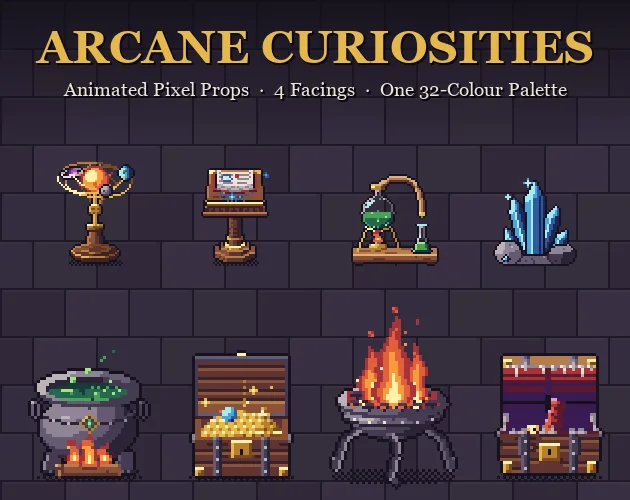 Arcane Curiosities Vol.112 animated props · 52 animations
Every sprite in these notes ships with its source
Tessarune includes all 72 Arcane Curiosities props and their full Tessarune source files as a bonus, so you can inspect, edit, and re-render every technique locally.