Controlled jitter: breaking picket-fence symmetry
Equal-length teeth, mirrored side flames, and embers blinking in lockstep turn organic game sprites into mechanical zippers. The fix is not per-frame randomness—which flickers—but controlled jitter: deliberate focal breaks paired with a pure deterministic hash(i, seed) that varies lengths, gaps, and phases identically on every frame.
Why uniform repetition makes living things look robotic
In Technique Note 04 we kept flat wooden planks and iron bands free of random per-pixel speckle so light planes stayed clean. Yet the opposite extreme—making every repeated feature identical in size, spacing, and timing—breaks organic subjects just as fast. A monster's jaw with ten equal-length upper teeth and nine equal lower teeth stops reading as a mouth and turns into a picket fence or a mechanical zipper.
The same thing happens in fire and coals. When two side flames share the exact same height and animation phase, they read like twin plastic cutouts flanking a centrepiece. When every coal lump in a brazier gets an identical horizontal crack pulsing at the exact same beat, the bed looks like a row of LEDs instead of burning charcoal.
You do not fix robotic symmetry by calling Math.random() inside a draw loop—random values per frame create jittery static. Instead, use controlled jitter: keep rigid structure (the chest silhouette, the riveted iron bowl) disciplined, then break repetition on organic parts with two tools—a few hand-placed focal breaks and a pure deterministic hash(a, b) seeded by element index.
Measured on two real Vol.1 props
For the first test, we rendered a uniform-teeth variant of the Mimic from Arcane Curiosities Vol.1 through Tessarune, replacing only the four tooth arrays in mimic.js (lines 42–46) with evenly spaced length-2.6 teeth (10 upper, 9 lower, no fangs, no gap, no hash jitter). On frame 5 of mimic-bite-down (48×48, 1,076 opaque pixels), exactly 84 pixels differ—7.8% of the whole sprite, and 84 of 341 opaque pixels (24.6%) inside the mouth band (47 upper-jaw pixels and 37 lower-jaw pixels). The deliberate omission of one upper tooth at x = -5 also changes the character's read completely: the real mimic exposes 11 pixels of its amber eye including the vertical ink slit pupil, whereas the uniform row clips it down to 6 amber pixels and hides the pupil. Even during the quieter breathing loop (mimic-idle-down frame 6), 43 of 969 opaque pixels (4.4%) differ.
To test controlled jitter on animated fire and embers, we rendered a uniform variant of the Wrought-Iron Brazier (brazier-idle-fire, 48×64, 1,169 opaque pixels) by removing its three deterministic variation rules: all 15 coal lumps received identical horizontal cracks pulsing on the same phase (removing hash(id, 3), hash(id, 7), and hash(id, 9) on lines 88–89), both side flames were equalised to height 19 with seed 0 (lines 115–119), and the six rising embers lost their hash(i, 1) sway offset (line 159). On frame 0 alone, 163 of 1,169 real opaque pixels (13.9%, or 163 of 1,200 union pixels = 13.6%) differ: 123 pixels across the flames, rising tongues, and embers, 40 pixels across the coal bed, and 0 pixels on the iron bowl, riveted strap, and legs. Across all 12 frames of the loop, 160 to 209 pixels differ per frame (175.3 pixels on average).
Mimic (48×48, bite-down frame 5)

Uniform teeth: 10 upper + 9 lower (all length 2.6, no fangs, eye pupil blocked at 6 px)

Controlled jitter: fangs at ±11 (4.4 / 4.2), x = -5 eye gap (11 px + slit pupil), hash(i, 11/13/17)

Pixel diff: 84 / 1,076 opaque px (7.8%) — 24.6% of the mouth band (47 upper + 37 lower)
Wrought-Iron Brazier (48×64, idle-fire frame 0)

Uniform fire & coals: mirrored side flames (h=19, seed 0), all 15 coals cracked in lockstep

Controlled jitter: h=18/20/28 with distinct seeds, 11/15 cracked coals (4 tilted), hash(i, 1) embers

Pixel diff: 163 / 1,169 opaque px (13.9%) on frame 0 — 123 flame/ember + 40 coal + 0 bowl/legs
Two longer lead fangs anchor the jaw against shorter uneven side teeth (2.2–3.0) so the mouth reads immediately.
Omitting one upper tooth over EYE_X = -5.25 uncovers the amber eye and its vertical ink slit pupil.
Lower front (2.33–2.86) and side rows vary deterministically by tooth index—organic silhouette with zero per-frame flicker.
Front and lid seams tilt slightly across the box so the mimic feels subtly wrong even when its lid stays shut.
Four deliberate breaks measured on mimic-bite-down frame 5 (48×48, 1,076 opaque pixels) and mimic.js.
Hand-placed focal breaks plus pure hash(i, seed)
Every Arcane Curiosities prop shares a one-line pure hash helper: hash(a, b) computes the fractional part of Math.sin(a * 127.1 + b * 311.7) * 43758.5453. Because it depends only on its integer arguments—never on frame counters or wall-clock time—every render is byte-identical and no jagged tooth or coal crack ever flickers in motion.
In mimic.js, the front upper row (UPPER_FRONT, lines 42–43) uses hand-authored focal breaks where the viewer's eye goes first: two slightly asymmetric fangs at x = ±11 (lengths 4.4 on the left and 4.2 on the right), shorter uneven neighbours between 2.2 and 3.0, and an intentional empty slot at x = -5 directly over EYE_X = -5.25 (line 37). The secondary rows then delegate their lengths to pure hashes: LOWER_FRONT uses 2.2 + 0.7 * hash(i, 11) (producing 2.33, 2.46, 2.53, 2.86, 2.42, 2.58 across its 6 teeth), UPPER_SIDE uses hash(i, 13) (2.93, 3.11, 2.60), and LOWER_SIDE uses hash(i, 17) (2.51, 2.38, 2.58). Line 246 adds one subtle structural warp—tilting the front chest planks with Math.floor((z + 0.09 * u + 0.6) / 4)—so the mimic looks slightly off even before the lid opens.
In brazier.js, the same pure hash drives three independent channels across the 15 coal lumps (9 BACK_LUMPS + 6 FRONT_LUMPS, lines 79–95): hash(id, 3) offsets each coal's pulse phase around the 12-frame loop, hash(id, 7) > 0.3 selects 11 of the 15 coals to carry a glowing crack (and > 0.72 leaves 6 of 15 with a dying r0 ember in the unlit variant), and hash(id, 9) > 0.5 tilts 4 of those 11 cracks downward by 1 pixel. Above the coals, FLAMES (lines 115–119) pairs unequal side heights (18 left vs 20 right, 28 centre) with distinct phase seeds (0.31, 0.64, 0.05), while line 159 desynchronises the 6 rising embers with hash(i, 1).
mimic.js lines 41–46 and 245–247: hand-authored fangs at ±11 and an eye gap at x = -5 on UPPER_FRONT, pure hash(i, 11 / 13 / 17) length variation on the remaining rows, and slightly sloped front planks (+0.09 * u).
// teeth: flat sheets on the seam planes. [centre along the edge, half-width, length]; uneven on purposeconst UPPER_FRONT = [[-13.6, 1.1, 2.2], [-11, 1.4, 4.4], [-8, 1.5, 2.7], [-2, 1.5, 2.9], [1.5, 1.5, 2.5], [5, 1.5, 3], [8, 1.5, 2.6], [11, 1.4, 4.2], [13.6, 1.1, 2.3]]; // fangs at +-11, a gap at x=-5 where the eye looks outconst LOWER_FRONT = [-11.5, -8.5, -2, 1, 7.5, 10.5].map((c, i) => [c, 1.5, 2.2 + 0.7 * hash(i, 11)]);const UPPER_SIDE = [-7.5, -4, -0.5].map((c, i) => [c, 1.7, 2.6 + 0.7 * hash(i, 13)]);const LOWER_SIDE = [-5.75, -2.25, 1.25].map((c, i) => [c, 1.5, 2.2 + 0.5 * hash(i, 17)]);⋯ // crooked planks: the seams slope across the face return { part: "body", mat: "wood", s: face, k: Math.floor((z + 0.09 * u + 0.6) / 4), u, z }; }brazier.js lines 79–95, 115–119, and 156–163: three hash channels for coal crack phase, selection (11/15), and 1-px tilt (4/11), unequal side flame heights and seeds, and hash(i, 1) ember sway.
const BACK_LUMPS = [[12, 31], [17, 30], [23, 29], [29, 30], [35, 31], [14, 33], [20, 32], [27, 32], [33, 33]];const FRONT_LUMPS = [[11, 34], [16, 35], [21, 35], [27, 35], [32, 35], [37, 34]];function lumps(g, t, lit, list, k0) { for (let i = 0; i < list.length; i++) { const [lx, ly] = list[i], id = i + k0; g.ellipse({ x: [lx - 2, lx + 2], y: [ly - 1, ly + 1] }, "n0", { fill: "n0" }); g.line([lx - 1, ly - 1], [lx + 1, ly - 1], "n1"); // lit top if (lit) { g.pixel(lx + 2, ly, "fl0"); // hot underside edge const p = 0.5 + 0.5 * Math.sin(TAU * (t + hash(id, 3))); // crack pulses on its own phase if (hash(id, 7) > 0.3) g.line([lx - 1, ly], [lx, ly + (hash(id, 9) > 0.5 ? 1 : 0)], p > 0.72 ? "fl3" : p > 0.36 ? "fl2" : "fl1"); } else { g.pixel(lx - 1, ly - 1, "n2"); // dull charcoal sheen if (hash(id, 7) > 0.72) g.pixel(lx + 2, ly, "r0"); // a dying ember in the gap } }}⋯const FLAMES = [ { name: "flameL", x: 17, base: 32, h: 18, hw: 4.6, lean: -2.5, seed: 0.31 }, { name: "flameR", x: 31, base: 32, h: 20, hw: 4.6, lean: 2.5, seed: 0.64 }, { name: "flameC", x: 24, base: 33, h: 28, hw: 7, lean: 0, seed: 0.05 },];⋯ g.detached("embers", () => { for (let i = 0; i < 6; i++) { const p = (t + i / 6) % 1; const x = CX + Math.round((i - 2.5) * 4 + Math.sin(TAU * (p * 1.5 + hash(i, 1))) * 2.5); const y = 26 - Math.round(p * 24); if (p < 0.92 && y >= 0) g.pixel(x, y, p < 0.3 ? "fl3" : p < 0.6 ? "fl2" : p < 0.8 ? "fl1" : "fl0"); } });Checklist for controlled jitter without visual chaos
Controlled jitter works because it is selective. Notice that in both props the underlying chassis stays completely disciplined: the mimic's brass lock and iron bands stay straight, and the brazier's iron bowl, riveted strap, and three legs have zero pixel difference between the uniform and final versions.
Reserve irregularity for the parts that carry life, wear, or organic motion—teeth, cracks, flames, embers, drips, and tilted boards—and always tie variation to an element ID rather than a random draw per frame.
- Keep rigid architecture clean and aligned; apply controlled jitter only to organic, living, or worn elements.
- Hand-author the focal breaks first (hero fangs, an intentional eye gap, a taller side flame), then use a pure hash(id, seed) for secondary repetition.
- Give each independent attribute its own hash seed (e.g. phase, presence, and tilt in brazier.js) so features do not correlate mechanically.
- Never use unseeded randomness inside a frame loop: deterministic jitter keeps silhouettes organic with zero per-frame flicker.
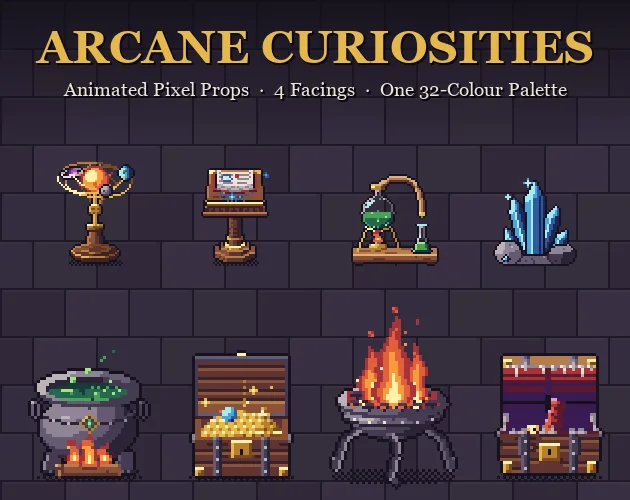 Arcane Curiosities Vol.112 animated props · 52 animations
Every sprite in these notes ships with its source
Tessarune includes all 72 Arcane Curiosities props and their full Tessarune source files as a bonus, so you can inspect, edit, and re-render every technique locally.