Anticipation, bite & squash: weight in 8–10 frames
Dividing a lid swing into equal angle steps turns a lunging monster or a heavy treasure chest into a mechanical hinge. In 8 to 10 frames, weight comes from three numbers working together: asymmetric timing, opposite width/height squash (sx and sz), and a brief overshoot that settles back to rest.
Why equal linear steps make pixel motion feel weightless
When you animate a 48×48 biting chest by stepping its lid angle evenly—five frames opening at +13.2° per frame to 66°, then five frames closing at -13.2° per frame back to 0°—nothing signals effort or impact. The silhouette stays locked at 37 pixels wide on every frame, the base never lifts off the floor, and the shut frame looks identical to the starting rest pose.
The same problem hits a non-combat prop like a treasure chest opening over 8 frames. Stepping steadily at +15° per frame from 0° to 105° makes the lid float upward on frame 1 as if driven by a motor, then stop dead on frame 7 with zero momentum.
You do not need a 24-frame spritesheet to fix this. Both mimic.js (10 frames at 10 fps) and chest.js (8 frames at 10 fps) drive their motion from compact keyframe tables that pair three deliberate beats: an anticipation windup or squat that moves opposite to the main action, a fast snap or surge 2.8× to 2.9× faster than a linear curve, and opposite horizontal/vertical scale factors (sx and sz) plus overshoot so the body visibly absorbs energy.
Measured on two real Vol.1 animations
For the first test, we rendered a naive linear baseline of the Mimic (mimic-bite-down, 48×48, 10 frames) through Tessarune by replacing BITE[10] in mimic.js (lines 376–388) with equal ±13.2°/f steps (0° → 66° → 0°), locking sx = 1, sz = 1, hop = 0, lunge = 0, and bulge = 0.04, and disabling the 12-pixel clack burst on frame 6 (lines 417–430). Comparing both animations at the exact same 0° shut angle—the real chomp impact on frame 6 against linear frame 0—shows 821 of 1,006 union pixels differ (81.6%). Where the linear chest stays rigid at 37×27 pixels on every closed frame, the real f6 impact flattens and widens the body to 41×24 pixels (sx = 1.07, sz = 0.86, bulge = 0.09), and the 12 detached spark pixels push the full horizontal span to 47 pixels (+10 px). At peak open (real f4 overshoot at 68° with hop = 2 and lunge = 1.5 vs linear f5 at 66°), 938 of 1,427 union pixels differ (65.7%; 37×41 px vs 37×39 px). On the elastic rebound immediately after impact (real f7 at 0° vs linear f0 at 0°), 532 of 959 union pixels differ (55.5%) as the body springs narrow and tall to 35×28 pixels (sx = 0.97, sz = 1.05). Across same-index frames f0–f9, differences run from 29.3% (f0) up to 90.9% (f6, 1,215 of 1,336 union pixels).
For the second test, we rendered a naive linear baseline of the Treasure Chest (chest-open-down, 48×48, 8 frames) by replacing OPEN_KEYS[8] in chest.js (lines 370–380) with equal +15°/f steps from 0° to OPEN (105°), locking sx = 1, sz = 1, and hop = 0 while keeping the light-ray curve identical. On frame 1 alone, 751 of 1,024 union pixels differ (73.3%): the linear chest immediately cracks open 15° (35×29 px, top edge y = 17), whereas the real chest holds 0° shut and squats down into anticipation (sx = 1.04, sz = 0.90), widening to 37×25 pixels (top edge y = 21). Even comparing that 0° squat against the 0° starting frame (f0) shifts 614 of 958 union pixels (64.1%). On frame 2, the real chest springs 1 pixel off the floor (hop = 1, body bottom y = 44 vs linear y = 45) while stretching narrow (sx = 0.97, sz = 1.06, 35×29 px) as the lid cracks 9°—differing by 729 of 1,079 union pixels (67.6%). The lid then surges +39° and +42° on frames 3 and 4 (2.8× faster than +15°/f), overshoots the 105° rest angle to 118° on frame 5 (44 px tall, y = 2; 514 of 1,413 px = 36.4% vs linear f5, and 620 of 1,413 px = 43.9% vs linear rest f7), rebounds under to 99° on frame 6 (255 of 1,408 px = 18.1%), and lands cleanly on 105° at frame 7 to match frame 0 of the opened loop.
Mimic (48×48, bite-down impact f6 vs linear 0° f0)

Linear 0° shut (f0): ±13.2°/f curve, locked sx=1 sz=1, rigid 37×27 px, no clack burst

Real chomp impact (f6, 0°): sx=1.07, sz=0.86, bulge=0.09 → 41×24 px + 12 px clack (47 px span)

Pixel diff at 0° shut: 821 / 1,006 union px (81.6%) move on squash + clack
Treasure Chest (48×48, open-down anticipation f1 vs linear f1)

Linear f1 (15°): equal +15°/f steps, locked sx=1 sz=1, cracks open immediately at 35×29 px

Real f1 anticipation squat (0°): sx=1.04, sz=0.90, widens +2 px and compresses -2 px to 37×25 px

Pixel diff on frame 1: 751 / 1,024 union px (73.3%) — squat alone shifts 614 / 958 px (64.1%) vs f0
Mimic · BITE[10] (mimic.js L376–388)
| Frame | th | sx × sz | hop / lunge / bulge | Measured body | Phase |
|---|---|---|---|---|---|
| f0 | 3.5° | 1.00 × 1.00 | 0 / 0 / 0.04 | 37×27 | Rest crack |
| f1 | 16° | 0.98 × 1.05 | 0 / 0 / 0.05 | 35×30 | Stretch windup |
| f2 | 50° | 0.97 × 1.07 | 1 / 0.6 / 0.05 | 35×38 | Coil + hop (+34°/f) |
| f3 | 66° | 1.00 × 1.04 | 2 / 1.5 / 0.06 | 37×41 | Wide lunge |
| f4 | 68° | 1.00 × 1.02 | 2 / 1.5 / 0.06 | 37×41 | Overshoot hang (+2°) |
| f5 | 30° | 1.00 × 1.00 | 1 / 1.0 / 0.05 | 37×31 | Snap down (-38°/f) |
| f6 | 0° | 1.07 × 0.86 | 0 / 0.5 / 0.09 | 41×24 (+12 px) | CHOMP squash + clack |
| f7 | 0° | 0.97 × 1.05 | 0 / 0 / 0.03 | 35×28 | Elastic rebound |
| f8 | 2° | 1.01 × 0.98 | 0 / 0 / 0.04 | 37×27 | Damp settle |
| f9 | 3° | 1.00 × 1.00 | 0 / 0 / 0.04 | 37×27 | Return to rest |
Treasure Chest · OPEN_KEYS[8] (chest.js L370–380)
| Frame | th | sx × sz | hop / light | Measured body | Phase |
|---|---|---|---|---|---|
| f0 | 0° | 1.00 × 1.00 | 0 / 0 | 35×27 | Closed start |
| f1 | 0° | 1.04 × 0.90 | 0 / 0 | 37×25 | Anticipation squat |
| f2 | 9° | 0.97 × 1.06 | 1 / 0.35 | 35×29 (y1=44) | Spring hop + first light |
| f3 | 48° | 1.00 × 1.00 | 0 / 1.0 | 35×36 | Fast swing (+39°/f) |
| f4 | 90° | 1.00 × 1.00 | 0 / 1.0 | 35×43 | Peak swing (+42°/f) |
| f5 | 118° | 1.00 × 1.00 | 0 / 0.8 | 35×44 (y0=2) | Overshoot (+13°) |
| f6 | 99° | 1.00 × 1.00 | 0 / 0.45 | 35×43 | Rebound (-6°) |
| f7 | 105° | 1.00 × 1.00 | 0 / 0 | 35×43 | Rest = opened f0 |
Exact keyframe parameters and measured 48×48 body silhouettes (excluding floor shadow row y = 46 and f6 detached clack sparks) for Mimic BITE[10] and Treasure Chest OPEN_KEYS[8].
One compact keyframe table drives all four facings
Because both props project a single 3D convex-solid model into any of the four facings, every timing and squash decision lives in one plain array of numbers rather than separate hand-drawn sheets per direction. Tuning the bite snap or chest squat means editing one row and re-rendering all four facings in lockstep.
In mimic.js (lines 376–388), each row of BITE[10] holds six values: [th, sx, sz, hop, lunge, bulge]. Frames 1 and 2 stretch the body taller and narrower (sx 0.98 → 0.97, sz 1.05 → 1.07) while lifting hop to 1 and accelerating the jaw by +34°/f. Frames 3 and 4 peak at WIDE (66°) and WIDE + 2 (68°) with hop = 2 and lunge = 1.5, creating a two-frame hang at the top of the arc so the viewer reads the teeth, palate, and tongue. Then frames 5 and 6 slam the jaw shut in just two frames (-38°/f, 2.9× faster than linear -13.2°/f, followed by -30°/f), inverting the scale on f6 to sx = 1.07, sz = 0.86, bulge = 0.09 while lines 417–430 fire 12 detached n5/n4 clack pixels from the front jaw corners. Frame 7 rebounds to sx = 0.97, sz = 1.05, and frames 8–9 damp smoothly back to the 3.5° idle crack.
In chest.js (lines 370–380), OPEN_KEYS[8] uses five values per frame: [th, sx, sz, hop, light]. Frame 1 keeps th = 0 while squashing down (sx = 1.04, sz = 0.90) to store potential energy; frame 2 releases it into an upward hop (hop = 1, sx = 0.97, sz = 1.06) as the lid cracks to 9° and light starts at 0.35; frames 3 and 4 swing wide at 48° and 90° with full light = 1; frame 5 swings +13° past rest to 118°; frame 6 rebounds to 99°; and frame 7 settles on OPEN (105°) with light = 0 so sparkles(g, fr, 0) on line 405 hands seamlessly into the opened idle loop.
mimic.js lines 376–388 and 413–430: the 10-frame BITE table [th, sx, sz, hop, lunge, bulge] and the f === 6 detached clack spark burst (12 pixels in n5/n4).
const BITE = [ // th, sx, sz, hop, lunge, bulge [3.5, 1, 1, 0, 0, 0.04], [16, 0.98, 1.05, 0, 0, 0.05], // the lid starts to rise, the body stretches [50, 0.97, 1.07, 1, 0.6, 0.05], [WIDE, 1, 1.04, 2, 1.5, 0.06], // wide open, lunging: teeth rows, palate, tongue lashing up [WIDE + 2, 1, 1.02, 2, 1.5, 0.06], [30, 1, 1, 1, 1, 0.05], // snapping down [0, 1.07, 0.86, 0, 0.5, 0.09], // CHOMP: squash [0, 0.97, 1.05, 0, 0, 0.03], // rebound [2, 1.01, 0.98, 0, 0, 0.04], [3, 1, 1, 0, 0, 0.04],];⋯ const f = Math.min(N_BITE - 1, Math.round(t * N_BITE)); const [th, sx, sz, hop, lunge, bulge] = BITE[f]; const st = { th, sx, sz, hop, lunge, bulge, tongue: Math.min(1, th / WIDE), sway: Math.sin(TAU * t + 1) }; const fr = drawMimic(g, face, st, { eyeGlint: f >= 2 && f <= 4 }); if (f === 6) { // chomp: clack marks burst from the front corners of the seam g.detached("clack", () => { for (const s of [-1, 1]) { const [sx0, sy0, dep] = fr.proj([s * (HL + 1), -HD - 1, H + 0.5]); const x = Math.round(sx0), y = Math.round(sy0); for (let k = 1; k <= 2; k++) { for (const [dx, dy] of [[s * (k + 1), -k], [s * (k + 2), 0], [s * (k + 1), k]]) { if (visible(fr.buf, x + dx, y + dy, dep - 3, 0)) g.pixel(x + dx, y + dy, k === 1 ? "n5" : "n4"); } } } }); }chest.js lines 370–380 and 399–407: the 8-frame OPEN_KEYS table [th, sx, sz, hop, light] with f1 squat anticipation, f2 spring hop, f5 118° overshoot, f6 99° rebound, and f7 seamless handoff to opened.
const OPEN_KEYS = [ // th, sx, sz, hop, light [0, 1, 1, 0, 0], [0, 1.04, 0.9, 0, 0], // anticipation: the chest squats [9, 0.97, 1.06, 1, 0.35], // springs up a pixel, lid cracks, first light [48, 1, 1, 0, 1], [90, 1, 1, 0, 1], [118, 1, 1, 0, 0.8], // swings past rest [99, 1, 1, 0, 0.45], [OPEN, 1, 1, 0, 0], // == opened, frame 0];⋯ if (state === "open") { const f = Math.min(N_OPEN - 1, Math.round(t * N_OPEN)); const [th, sx, sz, hop, light] = OPEN_KEYS[f]; const st = { th, sx, sz, hop, gold: th > 0 }; const fr = drawChest(g, face, st, { glow: light > 0.6 ? 1 : 0, backlit: face === "up" && th > 60 }); lightRays(g, face, st, fr, light); if (f === N_OPEN - 1) sparkles(g, fr, 0); return; }Checklist for heavy 8–10 frame pixel animations
Weight on a 48×48 canvas rarely comes from adding more in-between frames. It comes from spending frames unevenly: hold slightly longer at anticipation and apex, spend only 1–2 frames on the fast travel, and let the body deform for one frame on release or impact.
Notice that both props keep the product sx × sz close to 1.0 (mimic f6: 1.07 × 0.86 = 0.92; mimic f7: 0.97 × 1.05 = 1.02; chest f1: 1.04 × 0.90 = 0.94; chest f2: 0.97 × 1.06 = 1.03). Pairing opposite horizontal and vertical changes preserves perceived volume even when the shift is only 2 to 4 pixels wide.
- Spend 1–2 frames moving opposite to the main beat (a squat before opening, or a tall stretch before slamming shut) so the eye anticipates the release.
- Make the active strike or swing asymmetric: 2–3× faster than a linear average (mimic closes at -38°/f vs linear -13.2°/f; chest swings at +42°/f vs +15°/f).
- Keep horizontal and vertical deformation opposite (sx > 1 with sz < 1 on squash, sx < 1 with sz > 1 on stretch) so the sprite keeps its mass.
- Overshoot the target pose slightly (68° vs 66° hang, or 118° → 99° → 105° settle) and add a 1-frame impact accent like the 12-pixel clack burst on f6.
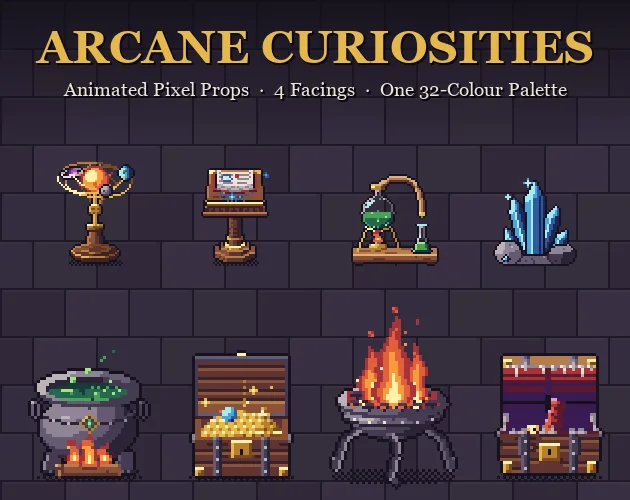 Arcane Curiosities Vol.112 animated props · 52 animations
Every sprite in these notes ships with its source
Tessarune includes all 72 Arcane Curiosities props and their full Tessarune source files as a bonus, so you can inspect, edit, and re-render every technique locally.